Museum
Musée de Montmartre
Inside the Maison du Bel Air, the Musée de Montmartre brings the hill’s artistic past back to the place where it unfolded. Paintings, artists’ rooms and the Renoir Gardens turn a museum visit into a journey through the neighbourhood’s creative history.
Selected by Arthur
Inside the artists’ Montmartre
The Musée de Montmartre is more than a collection displayed in a historic house. The house, the artists who worked here and the works that tell the neighbourhood’s story all belong to the same setting. That connection gives the visit an intimacy that a conventional gallery cannot reproduce.
Come for Renoir and Suzanne Valadon, but leave time for the wider picture. Paintings, posters and drawings reveal how studios and cabarets shaped Montmartre, while the recreated atelier-apartment and the three gardens make that history tangible beyond the display cases.
Houses, studios and gardens
It is easy to think of Montmartre’s artistic past as a collection of famous names and familiar posters. At the Musée de Montmartre, that history returns to a real house, a set of working rooms and gardens overlooking the hill. The setting is not simply a backdrop: it is part of the story.
A seventeenth-century house shaped by artists
Long before it became a museum, the Maison du Bel Air was a place to live and work. Built in the seventeenth century and counted among the oldest buildings on the hill, it welcomed artists whose lives are now inseparable from Montmartre.
Renoir lived here from 1875 to 1877. During that period he painted Le Bal du moulin de la Galette and La Balançoire on the site. Suzanne Valadon, Émile Bernard and Raoul Dufy worked here after him, adding their own chapters to the house’s artistic history. The museum, established here in 1960, therefore tells its story in a place that witnessed part of it first-hand.
Paintings, posters and the story of Montmartre
The permanent collections bring together paintings, posters and drawings rather than presenting a single artist or movement. Together they trace the changing life of the hill, the energy of its studios and the atmosphere of its cabarets, including Le Chat Noir.
This is where the museum’s real strength becomes clear. Familiar images of bohemian Montmartre are placed back into a broader history, connected to the people and spaces that created them. The collection is not only about how the neighbourhood looked, but about how it became an artistic world.
Valadon’s atelier-apartment and the Renoir Gardens
One of the most evocative parts of the visit is the atelier-apartment where Suzanne Valadon settled in 1912 with Maurice Utrillo and André Utter. Much of the original space had disappeared, so it was recreated from period letters, writings and photographs. The result adds a domestic dimension to names usually encountered only beside works of art.
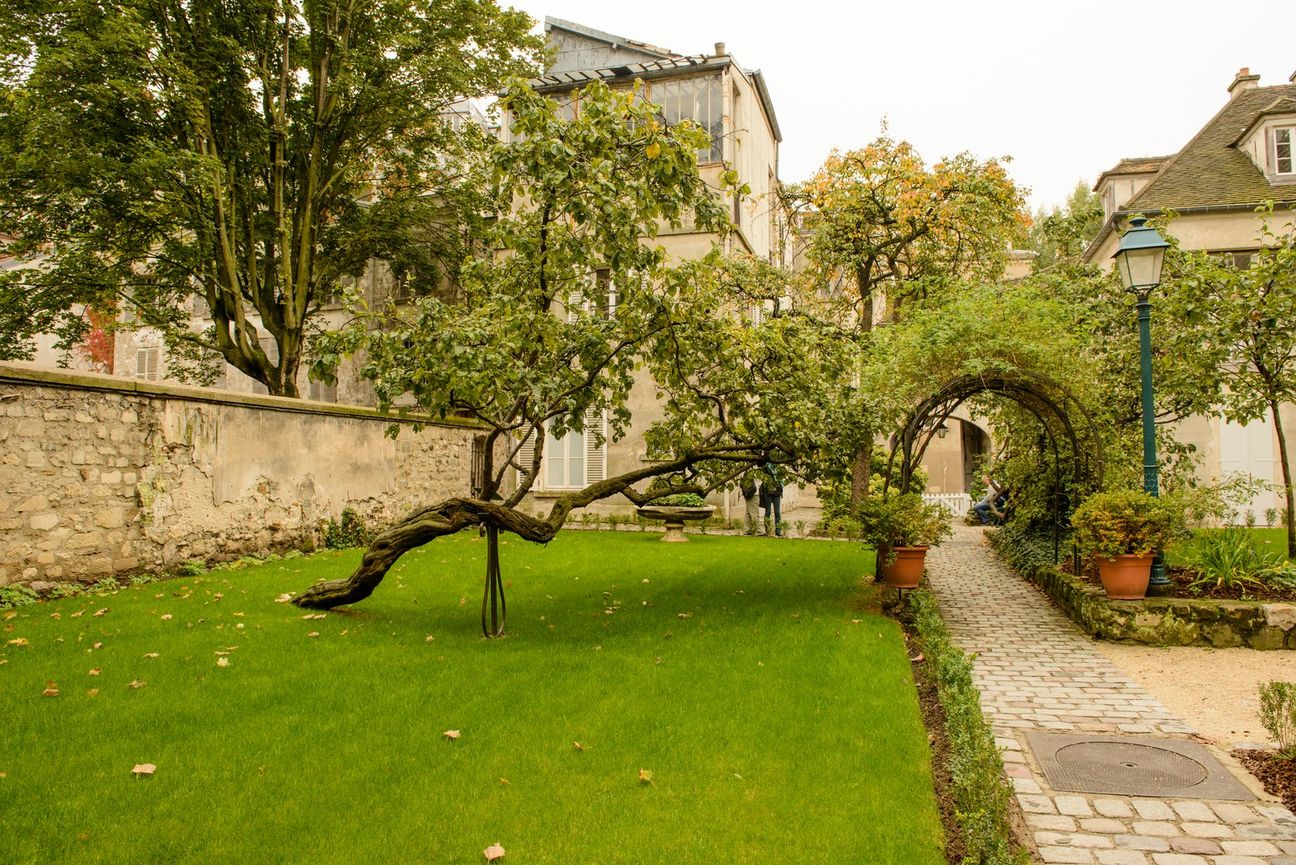
Outside, three gardens named in Renoir’s honour open towards the Clos Montmartre vineyard and northern Paris. They extend the visit into the landscape that surrounded the artists and give the museum a rhythm of rooms, memories and greenery.
That combination is what makes the Musée de Montmartre memorable. You do not simply learn that artists once lived on the hill; you see their history gathered in one of the places where it actually took shape.
Practical notes
Treat the historic rooms, Valadon’s recreated atelier-apartment and the Renoir Gardens as parts of one visit. Moving between them helps connect the collection’s paintings and posters with the places and people behind them.
The route through the permanent collections includes cobbles, small steps and staircases, so wear shoes with a stable grip on uneven surfaces. If step-free access is essential, note that access differs between the temporary exhibitions and the permanent collections.
Accessibility
The temporary exhibitions are accessible to visitors with reduced mobility by elevator.
The permanent collections are described by the museum as more difficult to access in a wheelchair because of cobbles, small steps and staircases. Accessibility is therefore partial and depends on the part of the site being visited.
Photo credits
Son of Groucho· CC BY 2.0· Wikimedia Commons · Resized; display crop may vary.
