Staircase
Rue Foyatier Steps
Beside the funicular, Rue Foyatier crosses the Montmartre slope through substantial stair sections along a hundred-metre public way.
Selected by Arthur
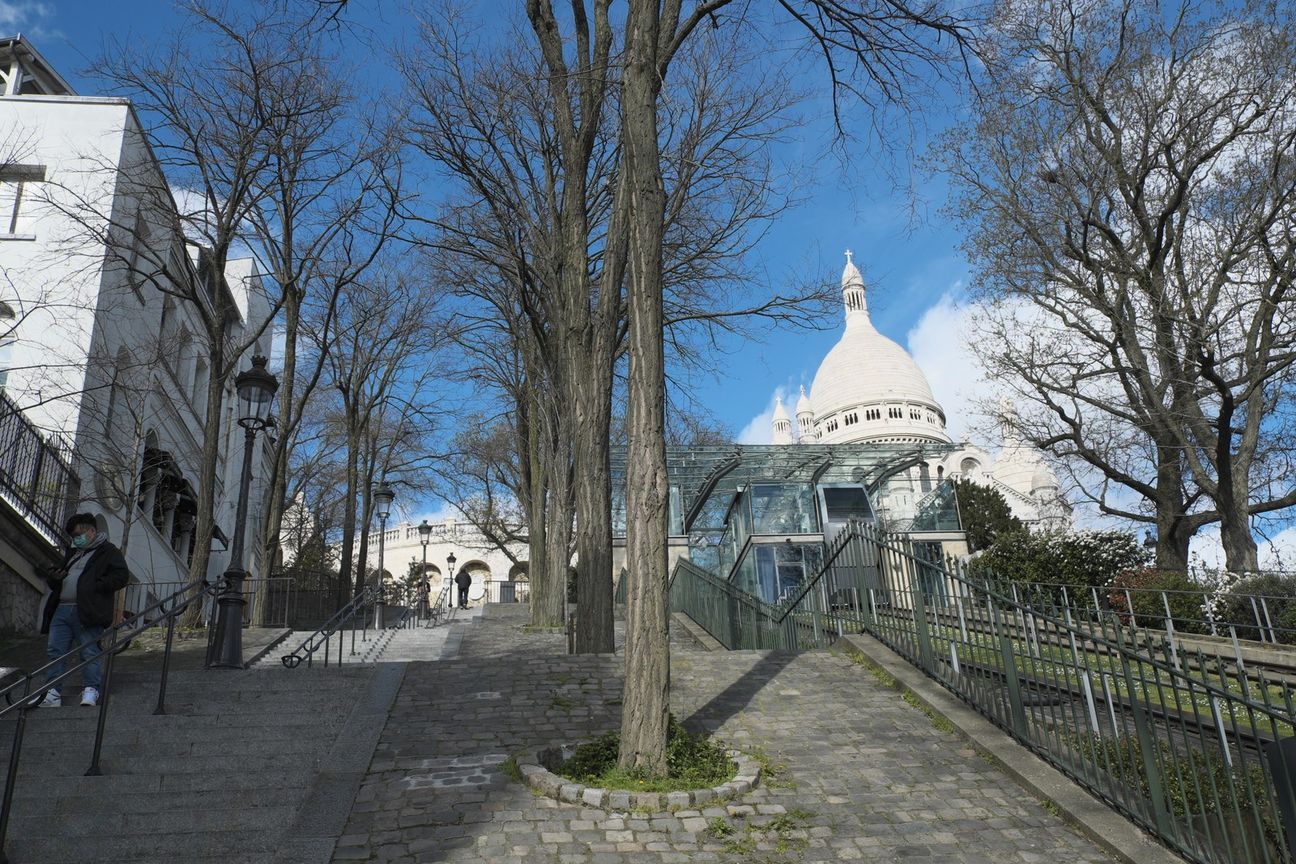
Montmartre, one step at a time
The Rue Foyatier Steps turn a steep climb into one of Montmartre’s most memorable urban experiences. They run beside the funicular, so the same slope appears in two parallel forms: one carried by machinery, the other climbed on foot. Few places make the relief of the Butte feel so immediate.
The effort is only part of the appeal. Rue Foyatier opened in 1867 and was named in 1875, in a neighbourhood where several streets honour sculptors. That history gives the climb a human scale: the passage from the lower streets to the hilltop becomes a short journey through the way Montmartre was shaped.
A street shaped by the slope
The official municipal name is simply Rue Foyatier. “Rue Foyatier Steps” is a descriptive name that helps visitors identify what they find on the ground, not an administrative title. In practice, this is a public street dramatically shaped by the slope.
A street that becomes a staircase
Rue Foyatier is one hundred metres long and twelve metres wide. It begins by Place Suzanne Valadon and 2 Rue André Barsacq, then climbs towards 5 Rue Saint-Éleuthère and Rue du Cardinal Dubois. Along this compact route, the municipal street plan records substantial staircase sections.
You may see an exact step count repeated elsewhere, but the official records available for Rue Foyatier do not publish one. The staircase hardly needs a number to make an impression: notice the rhythm of the landings and the way the slope reveals itself as you move.
Because this is a public way rather than a closed monument, the experience changes with your direction. Climbing brings effort and anticipation; descending reveals the structure of the route more gradually. Either way, the steps make Montmartre’s topography impossible to ignore.
From the 1867 opening to Denis Foyatier
The street was opened by the decree of 11 August 1867. Eight years later, the decree of 10 February 1875 named it after the French sculptor Denis Foyatier, who lived from 1793 to 1863.
The choice formed part of a wider local pattern, with several sculptors’ names grouped in this part of the neighbourhood. It is easy to miss while concentrating on the climb, yet it places Rue Foyatier within a deliberate layer of Parisian street history.
Part of the buildings on the odd-numbered side is also included in the site known as Vieux Montmartre. Look sideways as well as upward: the staircase may dominate the route, but the surrounding façades anchor it in a broader historic streetscape.
Reading the climb beside the funicular
The Montmartre funicular runs parallel to Rue Foyatier on the same slope. Seeing them together makes the geography unusually clear: rails and steps offer two different responses to the same change in level.
The funicular is neighbouring transport infrastructure, not part of the staircase itself and not an automatically guaranteed step-free route. Its proximity helps you read the hill, while Rue Foyatier remains an independent public way with its own history and dimensions.
At the top or bottom, turn around for one last look at the full alignment. The real interest lies in the relationship between the steps, the funicular, the façades and the slope. Together they show how Montmartre’s geography continues to shape the streets used every day.
Practical notes
Choose your direction before arriving. For the ascent, start near Place Suzanne Valadon and Rue André Barsacq; for a descent, approach from Rue Saint-Éleuthère or Rue du Cardinal Dubois. Comfortable footwear and an unhurried pace make the long stair sections easier to manage.
Do not plan around an exact step count seen elsewhere, as no official total is established here. If you intend to use the adjacent funicular instead, check its current operating conditions with the transport operator before travelling.
Accessibility
Rue Foyatier contains substantial staircase sections and is not a step-free route. Anyone unable to use stairs should not rely on the staircase itself as an accessible way to reach the upper part of the hill.
The funicular runs immediately beside the street and covers the same slope, but its operation and accessibility conditions may change. Check the transport operator’s latest information for guidance suited to your needs before relying on it as an alternative.
Photo credits
GFreihalter· CC BY-SA 3.0· Wikimedia Commons · Resized; display crop may vary.
