Park
Square Louise-Michel
On Montmartre’s southern slope, Square Louise-Michel turns the climb to Sacré-Cœur into a carefully composed landscape of stairs, paths and planting.
Selected by Arthur
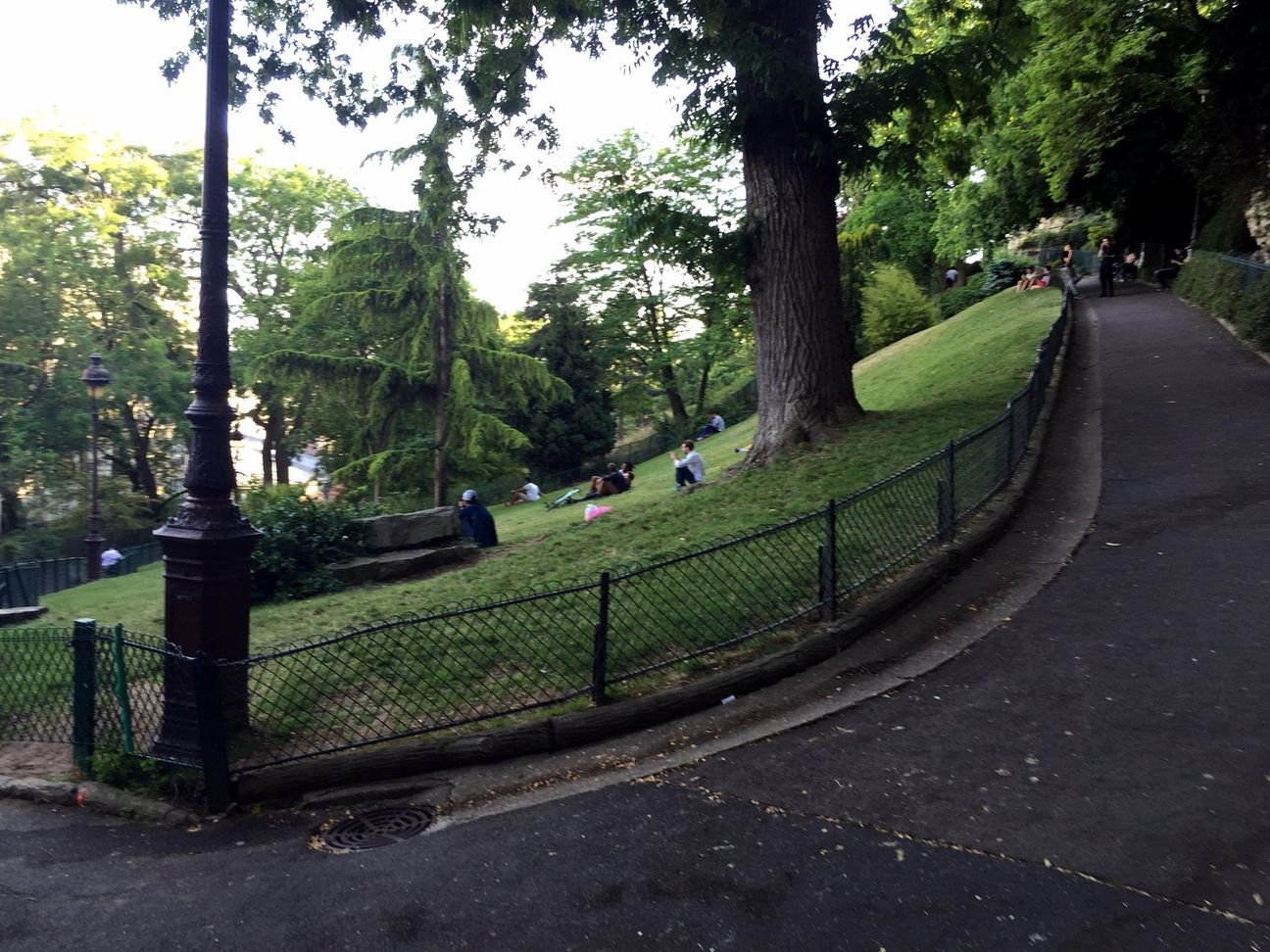
A garden beneath the basilica
Visit Square Louise-Michel to understand that the famous climb towards Sacré-Cœur is itself a designed landscape. The straight stairways, diagonal flights and planted slopes do more than connect two levels of Montmartre: together, they frame the basilica and turn the gradient into part of the monumental composition.
The garden also tells a less visible story. It was laid out over former gypsum quarries, took more than fifty years to complete and opened under another name before becoming Square Louise-Michel in 2004. Looking beyond the central staircase reveals a place shaped by geology, urban design and political memory.
The landscape of the ascent
It is easy to think of Square Louise-Michel as little more than the setting below Sacré-Cœur. The basilica draws the eye so strongly that the garden can seem like a simple route towards it. Pause at the lower part of the slope, however, and the composition becomes clear: this is a landscape with its own history, designed to make the ascent part of the experience.
A garden shaped over old quarries
The ground explains why the square took so long to emerge. This part of Montmartre had been occupied by quarries where gypsum was extracted for plaster, a material widely used in Parisian construction and decoration. The garden was imagined as early as 1880, but fragile soil required repeated consolidation.
Changes of architect and the construction of Sacré-Cœur also stretched the project across more than half a century. The square opened in 1927 under the name Square Willette, yet the City of Paris dates its final completion to 1932. What now feels like one coherent landscape was therefore assembled slowly over difficult ground.
The climb designed as a landscape
Jean-Camille Formigé and Léopold Bévière laid out the southern side of the hill for the City of Paris during the 1920s. Their most visible gesture is the monumental perspective: two large straight stairways, accompanied on either side by diagonal flights that form zigzags and lead towards the basilica.
The scale is larger than it first appears. The municipal record gives the square a total area of 25,539 square metres, including 12,500 square metres of planted ground. The central section is organised around the grand stairs, while the steeper eastern side follows walking paths through dense vegetation and rocky features.
That contrast deserves time. From below, look at how the stairs pull the eye towards Sacré-Cœur; then notice how quickly the geometry loosens at the edges. The garden shifts from monumental axis to planted hillside without losing its role in the larger composition.
From Square Willette to Louise Michel
The name changed in 2004. Louise Michel (1830–1905) was a teacher, writer and major figure of the Paris Commune whose political engagement led to years of exile in New Caledonia. Giving her name to the garden added a different history to a landscape long read mainly through the basilica above it.
The square’s built features, landscaping and boundary railings were included in the monument historique classification established by the order of 13 December 2022. The legal protection is shared with Sacré-Cœur and its annexes; it is one classification covering the ensemble, not a separate classification created for the garden.
Square Louise-Michel is most rewarding when both readings stay in view. It shapes one of Paris’s best-known approaches to a monument, yet its quarries, long construction and later name make it more than a stage set. Before climbing, take a moment to look at the garden itself: the route is already part of Montmartre’s story.
Practical notes
Begin at the lower end, on the Place Saint-Pierre side, and look at the whole central perspective before choosing a route. Treat the staircase and the garden as two different ways of reading the site: the direct stairs reveal its formal geometry, while the side paths show how planting and slope soften that monumental axis.
Do not rely on a fixed opening schedule or assume every section is available. Municipal access conditions can change, so consult the official City of Paris page shortly before your visit if a particular route matters to you. The site is large and steep enough to deserve comfortable shoes and an unhurried pace.
Accessibility
The City of Paris describes the square as accessible to people with reduced mobility.
The monumental central route towards Sacré-Cœur is nevertheless formed by stairways and conditions vary by area. This statement should not be read as proof that the entire garden is step-free.
Photo credits
Benoît Prieur· CC0 1.0· Wikimedia Commons · Resized; display crop may vary.
