Landmark
Moulin Rouge
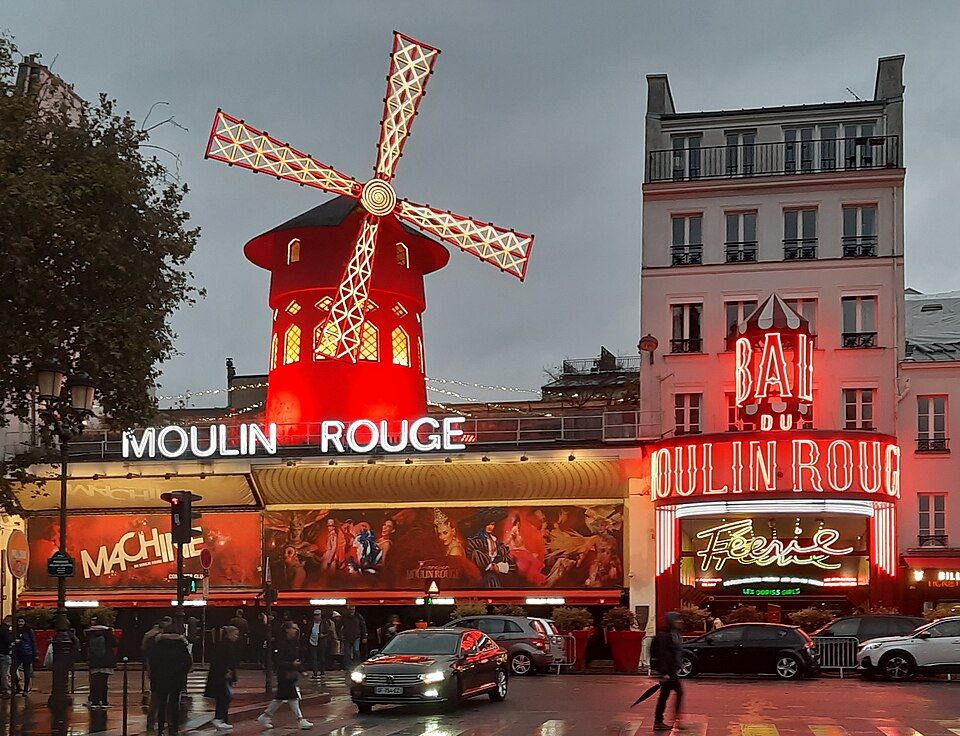
Opened in 1889 at the foot of Montmartre, the Moulin Rouge made its balls famous with the cancan and inspired Toulouse-Lautrec. Its red sails still mark the Boulevard de Clichy, near Place Blanche.
Selected by Arthur
A legend of Paris nights
Visit the Moulin Rouge for its place in the history of Paris nightlife. The cabaret opened on 6 October 1889, near Place Blanche, and its balls quickly became fashionable, with the cancan as their high point: La Goulue, Jane Avril and Valentin le Désossé became famous figures there. Toulouse-Lautrec was a regular, and the venue inspired several of his works.
There are two ways to experience it. From the boulevard, you can admire the facade and the windmill free of charge; in the evening, the revue “Féerie” carries on the music-hall tradition, on booking. Even if you do not see the show, knowing its story changes the way you look at the building.
From the 1889 ball to today’s revue
The Moulin Rouge is one of those places whose silhouette is familiar long before the first visit. Behind the red sails on the Boulevard de Clichy lies more than a century of Parisian entertainment: a dance hall opened in 1889, the cancan, Toulouse-Lautrec’s paintings and the great revues of the twentieth century.
A dance hall opened in 1889
The Moulin Rouge opened on 6 October 1889, at the foot of the Butte Montmartre, near Place Blanche. Its founders, Joseph Oller and Charles Zidler, gave the public a vast dance floor, mirrors everywhere, a gallery and a garden decorated with a giant elephant, where donkey rides were even on offer.
According to the Art Institute of Chicago, the venue was designed for electric lighting, a harsh artificial glare whose possibilities Toulouse-Lautrec would relish. As for the windmill that gives it its name, the Moulin Rouge explains that it pays tribute to the many windmills that once crowned the hill.
The cancan and Toulouse-Lautrec
The balls quickly became fashionable, with the cancan as their high point. Dancers such as La Goulue and Jane Avril became famous, alongside Valentin le Désossé.
Henri de Toulouse-Lautrec was a regular: he even had a permanently reserved table, according to the Art Institute of Chicago, which holds his painting “At the Moulin Rouge” (1892–95). In it, La Goulue arranges her hair in the background, Jane Avril sits at the table and the artist himself appears in the centre background with his cousin. In 1895 he also painted two large panels for La Goulue’s booth at the Foire du Trône, including “La Danse au Moulin Rouge”. Cut up in 1926 and reassembled in 1930, they are now in the Musée d’Orsay. According to the Moulin Rouge, seventeen of his works were directly inspired by the venue.
From dance hall to grand revue
The balls did not last forever: the last one was held on 29 December 1902, and the Moulin Rouge became a theatre-concert hall. Mistinguett made her debut there in 1907, in “La Revue de la Femme”.
After the Second World War, Jo France acquired the Bal du Moulin Rouge on 22 June 1951; the decor he imagined was largely executed by the painter Henri Mahé. From 1955 the Clérico family introduced the dinner-show formula, and from 1962 Jacki Clérico gave each revue a title beginning with F, a superstition that has become a tradition. The current revue, “Féerie”, in four tableaux, was first staged at the dawn of the 2000s; according to the Moulin Rouge, its high point is still the cancan, danced today by the Doriss Girls.
Seen from the pavement, the windmill is a photograph; with its story in mind, it becomes the doorway to a whole chapter of Parisian life.
Practical notes
The Moulin Rouge can be enjoyed in two ways. The facade and windmill can be seen at any time from the Boulevard de Clichy, as part of a walk between Place Pigalle and Place Blanche. The venue forbids photographing or filming the hall and the show, so take your photos outside.
To attend the revue, book ahead and check the conditions set by the Moulin Rouge before choosing a date: times, minimum age, requested dress, and exchange and cancellation terms. The revue includes scenes with nudity. The Métro station given by the Moulin Rouge is Blanche, on line 2.
Accessibility
The Moulin Rouge says it offers a specific welcome to visitors with reduced mobility and invites them to contact its booking service before the performance to prepare their visit. A Wi-Fi hearing-assistance system is available during the show for people with hearing loss.
See the revue at the Moulin Rouge
A booking for the revue “Féerie”, offered through GetYourGuide. Before booking, check the time, what is included, the minimum age and the requested dress.
Moulin Rouge Show with Champagne
Check availability on GetYourGuideOffer presented in English. Check dates, prices and conditions on GetYourGuide.
Transparency — MontmartreGuide may receive a commission if you book through links on this page.
Photo credits
Anvilaquarius· CC0 1.0· Wikimedia Commons · Resized; display crop may vary.
