Square
Place des Abbesses
Place des Abbesses holds two Montmartre stories at once: its name remembers the abbesses of the old abbey, while its Guimard Métro entrance arrived from elsewhere in Paris.
Selected by Arthur
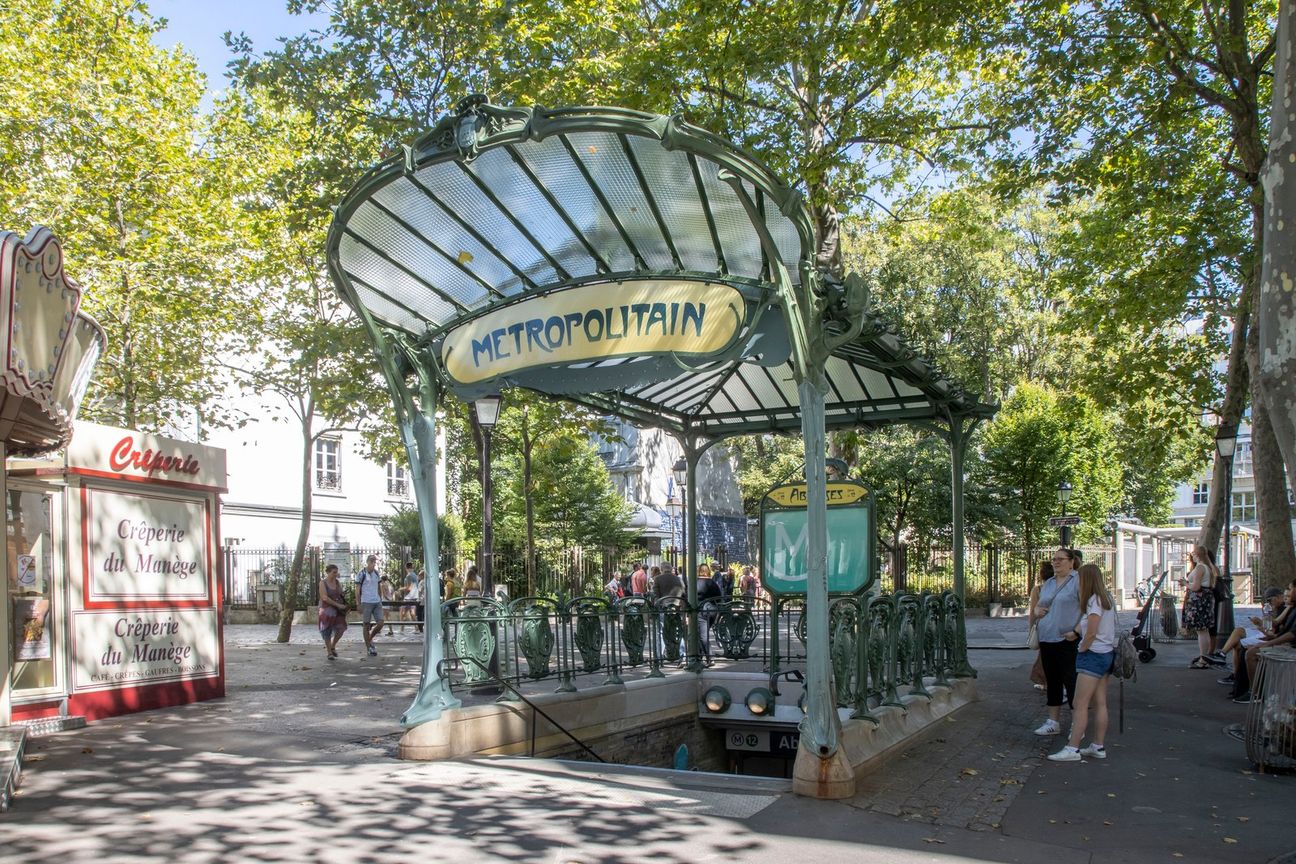
Two stories meet in one square
Visit Place des Abbesses for a detail that is easy to overlook: the square and its most distinctive Métro entrance do not share the same origin. The name reaches back through Rue des Abbesses to the abbesses of Montmartre’s former abbey, while the covered entrance began its life at another station.
That contrast makes the stop especially rewarding. In a small public square, you can trace the square’s incorporation from the former commune of Montmartre into the Paris street network and then follow the journey of a piece of Métro architecture designed in 1900. What looks as though it has always belonged here is actually the meeting point of two separate histories.
From the abbey to the Métro
Place des Abbesses is the kind of square many people cross while concentrating on what comes next. Yet the best reason to pause is already in front of you. Its name carries the memory of old Montmartre, and the covered Métro entrance at its edge tells a second story—one that began across Paris and arrived here decades after it was built.
A name inherited from the abbesses of Montmartre
The square opens onto Rue des Abbesses, where Rue Yvonne Le Tac and Rue La Vieuville meet. Its present name comes from the neighbouring street, whose own name remembers the abbesses of the former Montmartre abbey. The history is preserved without needing to turn it into a legend: a religious title passed into the everyday geography of the neighbourhood.
The place was once called Place de l’Abbaye. On 23 May 1863, a decree transferred it from the former commune of Montmartre to the Paris street network; an order dated 26 February 1867 then gave it the name Place des Abbesses. Those two administrative steps quietly established the square within modern Paris while keeping a link to what came before.
A Guimard entrance that travelled across Paris
The covered Métro entrance seems so closely matched to Abbesses that it is tempting to assume Hector Guimard designed it for this exact spot. He did not. Guimard created the surround in 1900 for the Compagnie générale du Métropolitain de Paris, and it originally stood at Hôtel de Ville station on line 1, at the Rue Lobau entrance.
It was dismantled in 1972 when an underground car park was built. Two years later, in 1974, it was moved and reassembled at Abbesses. The structure therefore crossed Paris and changed lines before becoming the architectural marker visitors recognise on the square today.
This journey is the detail that brings the object to life. It is not a reproduction made to decorate Montmartre, but a historic entrance with its own documented route through the city. Once you know that, the curves of the canopy feel less like a timeless stage set and more like a surviving piece of architecture with a journey of its own.
Why the entrance is an architectural exception
Its arrival at Abbesses created an unusual situation. Guimard had never designed entrance surrounds for this line of the former Nord-Sud network. The work now frames access to line 12, but its design belongs to a different original commission and a different station.
The entrance had first been listed in July 1965, before its dismantling. Its current registration as a French monument historique dates from the order of 12 February 2016, which protects the surviving Guimard Métro works as a group. The legal detail matters: the structure is registered, not classified, and its protected identity follows it beyond its first location.
Place des Abbesses is most interesting when these layers are read together. Look first at the name on the square, then at the entrance beside it. One preserves the memory of Montmartre’s abbesses; the other travelled from Hôtel de Ville. Their stories began apart, but today they meet within the same few metres of Paris.
Practical notes
Begin by locating the square on Rue des Abbesses, where Rue Yvonne Le Tac and Rue La Vieuville meet, then walk around the covered Métro entrance rather than viewing it only from the stairs. Seeing the whole surround makes it easier to understand it as a freestanding historic object, not simply a sign above the station.
Keep its journey in mind as you look: designed in 1900, first installed at Hôtel de Ville, dismantled in 1972 and moved here in 1974. Place des Abbesses is a public square without a single entrance or prescribed circuit, so this short architectural pause can fit naturally into a wider Montmartre walk.
Photo credits
Arthur Weidmann· CC BY-SA 4.0· Wikimedia Commons · Resized; display crop may vary.
