Square
Place du Tertre
Place du Tertre is small enough to cross in moments, yet its few metres hold centuries of Montmartre history and the City-authorised artists who still work in the open air.
Selected by Arthur
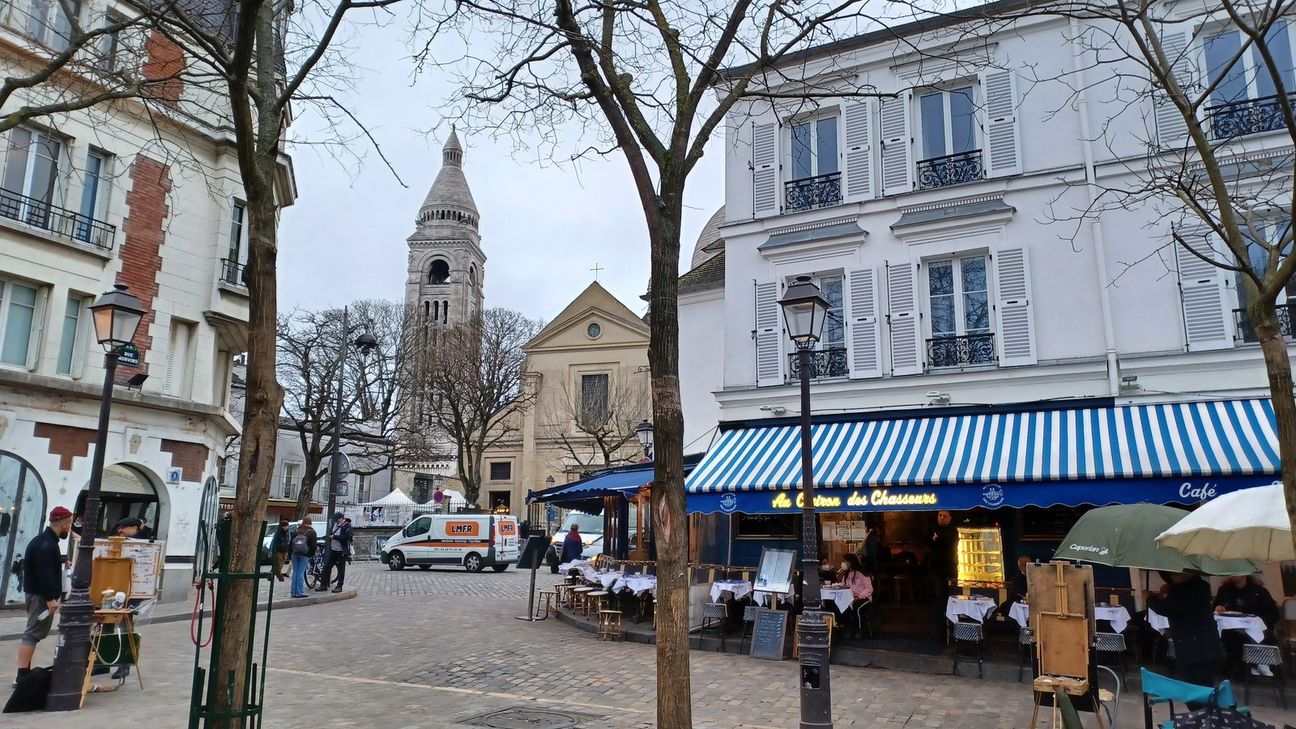
Behind the artists’ square
Visit Place du Tertre to look beyond one of Montmartre’s most familiar scenes. The square may feel spontaneous when artists are working in front of passers-by, but both the space and the activity within it have a precise history. Knowing that story changes the way you see the easels, portraits and silhouettes around you.
The appeal lies in the contrast between scale and memory. This is a square of only 38 metres by 35, yet it appears on a map dated 1672, was incorporated from the former commune of Montmartre into the Paris street network and even survived a decree that planned its removal. Few places on the hill fit so much urban history into such a compact setting.
A square shaped by history and painting
Place du Tertre is easy to approach as a ready-made image of artistic Montmartre. Arrive among painters and portraitists, however, and a more interesting story begins to emerge. The square is neither a vast historic plaza nor an informal gathering that simply appeared one day: it is a small public space shaped by centuries of city history and a closely organised artistic scheme.
A small square with a long memory
The first thing to notice is the scale. Place du Tertre measures just 38 metres by 35, between the end of Rue du Calvaire and Rue Norvins. You can cross it quickly, but a fast crossing makes it easy to miss how much of Montmartre’s past is contained within those few metres.
A square already appears here on a map dated 1672. That does not mean the scene looked as it does today; it simply anchors the place far earlier than the modern image usually associated with it. The square’s name also refers to its position on the heights of Montmartre, tying its identity directly to the hill.
From the commune of Montmartre to Paris
Place du Tertre once belonged to the street network of the former commune of Montmartre. By decree on 23 May 1863, it entered the Paris street network. The administrative status changed, but the small square remained a recognisable point on the hill.
Its survival was not guaranteed. A decree issued in 1867 planned to remove the square altogether. That unrealised decision is one of the most surprising details in its history: the place now associated so strongly with Montmartre might have disappeared during the remaking of the neighbourhood.
Today it lies within the site known as Vieux Montmartre. Read in that context, the square is more than a picturesque pause. Its dimensions, long history and survival form part of the historic fabric visitors have come to see.
How the Carré aux artistes really works
Their presence is not simply an informal tradition. Within the Carré aux artistes, the City of Paris authorises painters, portraitists, caricaturists and silhouette artists to work in the open air. The official description is wonderfully direct: artists paint, draw, make portraits, caricatures and cut-out silhouettes in front of passers-by.
Behind that visible activity is a regulated system. Each artist works on a numbered pitch in alternation with another artist. Authorisations last seven years, and applications are assessed according to artistic experience and technical skill. The arrangement explains why the square can feel like an open-air studio while still following rules that are largely invisible to the visitor.
That is the detail worth carrying through the visit. Place du Tertre is compelling not because it confirms a simple legend of bohemian Montmartre, but because an old public square and a living municipal art scheme continue to occupy the same few metres. Watch the work taking shape, then look back at the boundaries of the square: the present scene makes more sense once its structure and history are visible together.
Practical notes
Walk around the full 38-by-35-metre square instead of stopping at its first cluster of easels. Following the edge from the Rue du Calvaire side towards Rue Norvins makes the modest scale clear and helps you read the artists’ area as part of the square rather than as a separate attraction.
Look beyond finished works and take time to notice the different practices named by the City: painting, portraiture, caricature and silhouette cutting. Place du Tertre is a public square, not a monument with one entrance or a prescribed circuit, so it fits naturally into a wider walk through Vieux Montmartre.
Photo credits
Jean-Paul Corlin· CC BY-SA 4.0· Wikimedia Commons · Resized; display crop may vary.
