Square
Place Pigalle
At the foot of Montmartre, Place Pigalle keeps the memory of an old Paris city gate, an eighteenth-century sculptor and the café that serves as the setting of Degas’s “L’Absinthe”.
Selected by Arthur
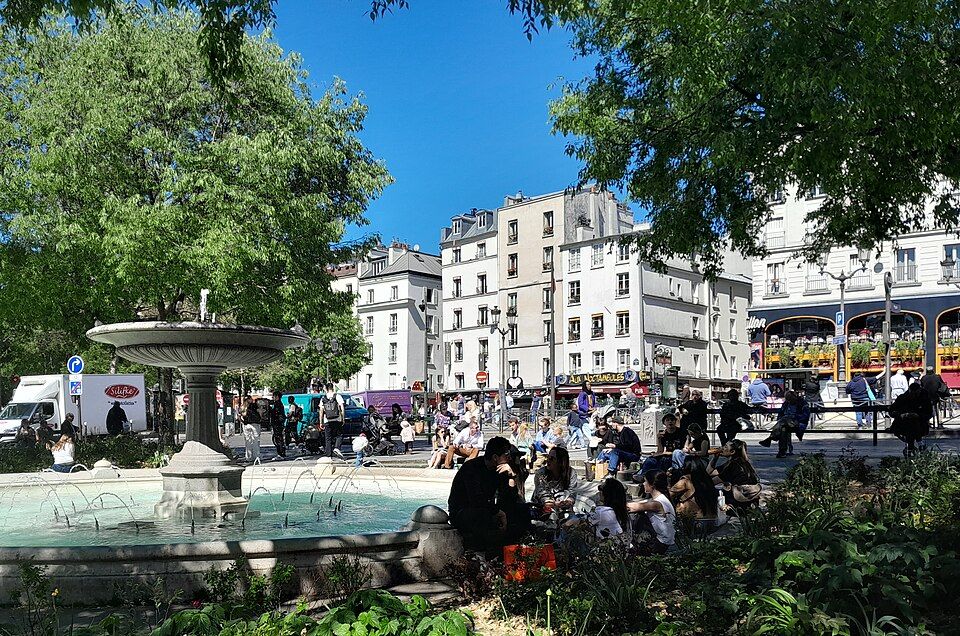
At the threshold of Montmartre
Place Pigalle is the threshold of Montmartre rather than part of the hill. The circular square lies in the 9th arrondissement, on the southern side of the Boulevard de Clichy, yet its former name, Place de la Barrière Montmartre, recalls a gate in the old octroi wall that bore Montmartre’s name.
Within a few steps, the square brings together several layers of Paris: the sculptor Jean-Baptiste Pigalle, who had his studio in the neighbouring street; La Nouvelle Athènes, the artists’ café identified as the setting of Degas’s “In a Café”; and a Métro entrance designed by Hector Guimard and listed as a historic monument. Knowing them turns a simple crossroads into a page of history.
From a city gate to Degas’s café
Place Pigalle is often crossed by people already thinking about the climb to Montmartre. Yet this round square on the edge of the Boulevard de Clichy is a small history lesson in itself: an opening decided in 1789, a name borrowed from a sculptor, a café where modern artists met, and a Métro entrance now protected as a historic monument.
From a city gate to Place Pigalle
The square was opened by an ordinance of the Bureau des Finances dated 16 January 1789. It was then called Place de la Barrière Montmartre, after a gate in the old octroi wall, the boundary where Paris levied duties on goods entering the city. The Boulevard de Clichy still follows the line of that wall: on its Paris side, the stretch between Place Pigalle and Place Blanche was once called the chemin de ronde de Montmartre.
An order of 30 December 1864 gave the square its present name. It comes from the neighbouring street, which honours the Paris-born sculptor Jean-Baptiste Pigalle (1714–1785), who had his studio there. The square is circular, with an official radius of 37.5 metres, and it is adorned with the Pigalle fountain.
The café in Degas’s “L’Absinthe”
The square also has its place in art history: the café La Nouvelle Athènes stood here. The Musée d’Orsay identifies it as the setting of Edgar Degas’s “In a Café”, also known as “L’Absinthe”, painted between 1875 and 1876, and describes it as a meeting place for modern artists and an intellectual hub of bohemian Paris.
The scene looks like a snapshot taken from the next table, but the museum stresses that this impression was carefully built: the picture was painted in the studio, not on the spot. Its models were the actress Ellen Andrée and the painter-engraver Marcellin Desboutin. To see the painting itself, you need to visit the Musée d’Orsay; on the square, it is the memory of that café that gives the place its depth.
A Guimard entrance on the boulevard
The Métro adds one more layer. The entrance to Pigalle station, on the Boulevard de Clichy facing no. 15, was designed in 1900 by Hector Guimard for the Compagnie générale du Métropolitain de Paris; the station lies on a section of line 2 opened in 1902.
Its surround has been listed as a historic monument since an order of 12 February 2016, which protects all of Guimard’s surviving works for the Métro. Take a moment to look at its curves and lettering before heading underground.
Place Pigalle does not call for a long visit. A few minutes are enough to find the fountain, picture the old city gate and continue along the Boulevard de Clichy: further west, at no. 82, near Place Blanche, the red sails of the Moulin Rouge take up the story of the boulevard.
Practical notes
Place Pigalle is a public square with no entrance or set route, so it fits easily into a walk toward Montmartre. Start at the fountain, then find the Guimard entrance of Pigalle station on the Boulevard de Clichy, facing no. 15.
Rue Duperré, which opens onto the square, leads to the Duperré basketball court at no. 22: tucked between two buildings, it is presented by the City of Paris as a work of street art. It is a sports ground in everyday use, so watch without getting in the players’ way. The Moulin Rouge is further along the same boulevard, at no. 82.
Photo credits
Paul de Belleville· CC0 1.0· Wikimedia Commons · Resized; display crop may vary.
